
The Agentic Reality Check:
Why Enterprise BI is Failing and How to Fix It
A Comprehensive eBook on the 2026 Analytics Revolution

Executive Summary:
The 2026 Analytics Paradox
The year 2026 was supposed to be the era of effortless insight. Enterprises have spent the last three years pouring billions into modern data stacks, cloud warehouses, and generative AI sidekicks. Yet, the fundamental experience of the business leader has remained remarkably stagnant. We find ourselves in a paradox. Organizations have more data than ever, yet most leaders report that they still cannot get a simple answer to a complex question in under twenty-four hours. We are surrounded by AI yet starved for true agency. This ebook explores the transition from passive dashboards to autonomous agents and why this shift is the only way to close the value realization gap in modern enterprise.
We are moving past the point where “having data” is enough. In 2026, the competitive advantage lies in how quickly that data can be turned into autonomous action. This guide will walk you through the end of the Dashboard Era and the beginning of the Agentic Era, specifically focusing on how Lumenore is building the bridge between the two.
For decades, Business Intelligence has followed a single, rigid philosophy: “If we show them the data, they will make better decisions.” This led to the Dashboard Era. We built massive warehouses and covered them with colorful charts, thinking that visibility was the same thing as understanding. In 2026, we realized that this philosophy had reached its biological limit. A human manager can only process a certain number of visualizations before “Dashboard Fatigue” sets in. When a leader is presented with 20 tabs to track a single KPI, the data stops being a tool and becomes a chore.
The Fatigue of Manual Interpretation
The real crisis isn’t a lack of data; it is a surplus of noise. Every morning, executives across the globe log into portals that are masterpieces of engineering but failures of communication. They see spikes, dips, and plateaus, but the “Why” is always missing.
The human brain is wired for stories, not coordinates on a grid. When we force a Sales VP to spend three hours a week “drilling down” into regional performance charts, we are essentially asking a high-value decision maker to do the work of a junior data entry clerk. This misallocation of talent is the hidden cost of traditional BI. We have turned our leaders into investigators when they should be strategists.
The Psychological Toll of Information Overload
Beyond the lost hours, there is a psychological cost to the way we currently handle data. When a manager feels they cannot “keep up” with the dashboards, they begin to ignore them. This is a survival mechanism. We call this “Analytical Blindness.” When the data is too complex to be useful, leaders revert to “gut feelings.” They make decisions based on past experiences rather than current reality. In a fast-moving market, this is a recipe for disaster. We need a system that filters the noise and presents only the “Signal.”
The core failure of traditional BI is its passivity. A dashboard sits there, waiting for you to look at it. It doesn’t know your goals; it doesn’t understand your urgency, and it certainly doesn’t know “why” a number is moving.
This creates the “Insight Bottleneck.” When a business leader sees a red flag on a chart, they cannot act immediately. They have to call a meeting or submit a ticket to a data analyst to dig into the root cause. By the time the analyst returns with an explanation, the market has moved, the customer has left, or the budget has been wasted. We are data-rich but “insight poor” because our tools lack the ability to reason.
The Architecture of a Bottleneck
In a typical Fortune 500 company, the average “time to insight” is still measured in days. Think about the friction involved in a simple question: “Why did our customer acquisition cost go up in UK region yesterday?”
- The manager sees the spike on Monday morning.
- The manager emails the data team by Monday afternoon.
- The data team, already working on five other “priority” requests, puts it in the backlog.
- An analyst pulls logs from the CRM, the advertising platform, and the regional sales database on Wednesday.
- A week later, a PDF summary will be sent back.
By the time the manager reads that PDF, the marketing campaign that caused the spike has already spent another 50,000 dollars in wasted budget. Passivity is expensive. In 2026, “real time” doesn’t just mean the data is fresh; it means the reasoning is fresh.
Continue Reading This E-Book
To solve this crisis, we have to move beyond the chatbot. In the early 2020s, Generative AI captured our imagination by being a great “Writer.” It could summarize a document or draft an email. But writing is not the same as doing it.
What is Agentic AI?
The agentic AI meaning in 2026 centers on “Goal-Oriented Execution.” While Generative AI is a solo performer that waits for a prompt, Agentic AI is an operator that pursues a goal.
An agentic system doesn’t just give you a response; it creates a plan. It perceives its environment, reasons for the best path forward, selects the necessary tools, and executes. If it encounters an error, it doesn’t just stop; it self-corrects and tries a different approach. This is the “Agentic Loop.” It is the transition from a tool that talks to a partner that works.
The Four Stages of the Agentic Loop
To understand how this works in a business context, we can break down the “Loop” into four distinct phases:
Perception: The agent scans the environment. It checks the live data feeds, reads the latest PDF reports, and monitors the market trends.
Reasoning: The agent asks itself, “What does this mean for the user’s goal?” If the goal is “Minimize waste,” and the agent sees a price hike, it is reasonable that it needs to find a cheaper supplier.
Action: The agent uses a tool. It might query a different database or draft a message to a procurement lead.
Learning: The agent observes the result of its action and refines its future behavior.
The difference is fundamental. If you ask a Generative AI, “Why are sales down?”, it might give you a list of general reasons based on its training data, like “seasonal trends” or “economic shifts.”
If you ask an Agentic AI solution the same question, it will log into your CRM, pull the latest regional reports, cross-reference them with your marketing spend, and tell you exactly which campaign is underperforming.
Lumenore’s Agentic AI framework changes the dynamic from guessing to executing. It uses Data Magnet as its ingestion engine to seamlessly connect to your live databases, CRMs, and data warehouses without complex setup. Once connected, Retrieval-Augmented Generation (RAG) acts as the cognitive bridge. Instead of relying on pre-trained memory, RAG allows the AI to securely fetch the exact, real-time records needed to answer your prompt.
Because of this architecture, a Lumenore AI agent doesn't just draft a reply. It triggers a precise operational workflow:
- Ingestion: Data Magnet instantly surfaces the latest live regional sales reports and marketing spend.
- Retrieval: RAG isolates the exact anomalies in your Q2 data, filtering out the noise.
- Analysis & Action: The agent cross-references the drop with a recent drop in ad impressions, pinpointing a specific underperforming campaign, and delivers a data-backed, verified answer.
Generative AI stops at conversational text. Lumenore’s Agentic AI executes a secure, data-backed workflow to give you the exact truth.
The Analyst vs. The Author
One is an author; the other is an analyst. In 2026, businesses don’t need more authors. We have enough content. What we need are agents that can handle the “heavy lifting” of data investigation autonomously.

Generative AI is like a smart intern who has read every book but has never worked in your office. Agentic AI is like a senior partner who has the keys to the filing cabinet, knows how to use the software, and has the authority to run a report. The value of agency is that it moves the “burden of labor” from human to the machine. We are shifting from “AI as a feature” to “AI as a workforce.”
Lumenore was built to be the operating system for this new era. We recognized early on that for an agent to be useful in a business context, it couldn’t just be “smart.” It had to be governed, transparent, and deeply connected to the “messy” reality of enterprise data.
The Master Agent: Your Digital Orchestrator
At the heart of the Lumenore ecosystem is the Master Agent. Think of this as the orchestrator of your intelligence. When you ask a question through Lumenore Ask Me, you aren’t just talking to a single model. You are talking to a coordinator who understands your business intent.
The Master Agent evaluates your request and decides which specialized “Sub-Agent” is best suited for the task:
The Translator. It bridges the gap between human language and machine logic. It parses your conversational questions, no matter how messy, and translates them into precise data queries, so the other agents know exactly what to look for.
Dedicated Root Cause Analysis. It digs into the “why” behind the numbers. If your margins are shrinking, the RCA agent finds the specific line of items responsible.
The storyteller. It doesn’t just make a chart; it selects the best way to present the data and writes a plain-English narrative to explain it.
The Prophet. It uses predictive models to show you where your current trends are heading if you don’t change the course.

This division of labor ensures that the AI is never “guessing.” Each sub-agent is a master of its specific domain, providing a level of depth that a general-purpose AI simply cannot match.
One of the biggest hurdles for AI adoption is trust. Leaders are rightfully wary of making million-dollar decisions based on a “hunch” from a machine. This is the “Black Box” problem, and it is the primary reason many AI projects never make it past the pilot stage.
Lumenore addresses this by providing a complete “Reasoning Path.” This is a transparent log of every thought the agent had. You can click into any insight and see exactly how the Master Agent reached its conclusion.
- Which databases were queried?
- Which filters were applied?
- Which logic was used to connect point A to point B?
Turning “Magic” into “Method”
This transparency turns “AI Magic” into “Auditable Intelligence.” It gives the CFO and the CEO the confidence to act on the agent’s recommendations because they can see the evidence. In the agentic era, trust is not given; it is earned through visibility. When an agent suggests a strategy shift, you don’t have to take its word for it. You can see math, sources, and rationale.
One of the most significant pain points businesses faces is that 80% of their “truth” isn’t in a database. It is trapped in unstructured formats: PDFs of contracts, transcripts of sales calls, and long email chains with vendors.
Traditional BI is blind to this information. If your dashboard shows that a vendor has increased their prices, you have to manually hunt through your shared drives to find the original contract to see if that increase is legal. This manual search is a massive drain on productivity and a major source of error.
RAG-Based Analysis in Action
Lumenore bridges this gap through Retrieval-Augmented Generation (RAG). Our agents treat your unstructured documents exactly like they treat a SQL table.
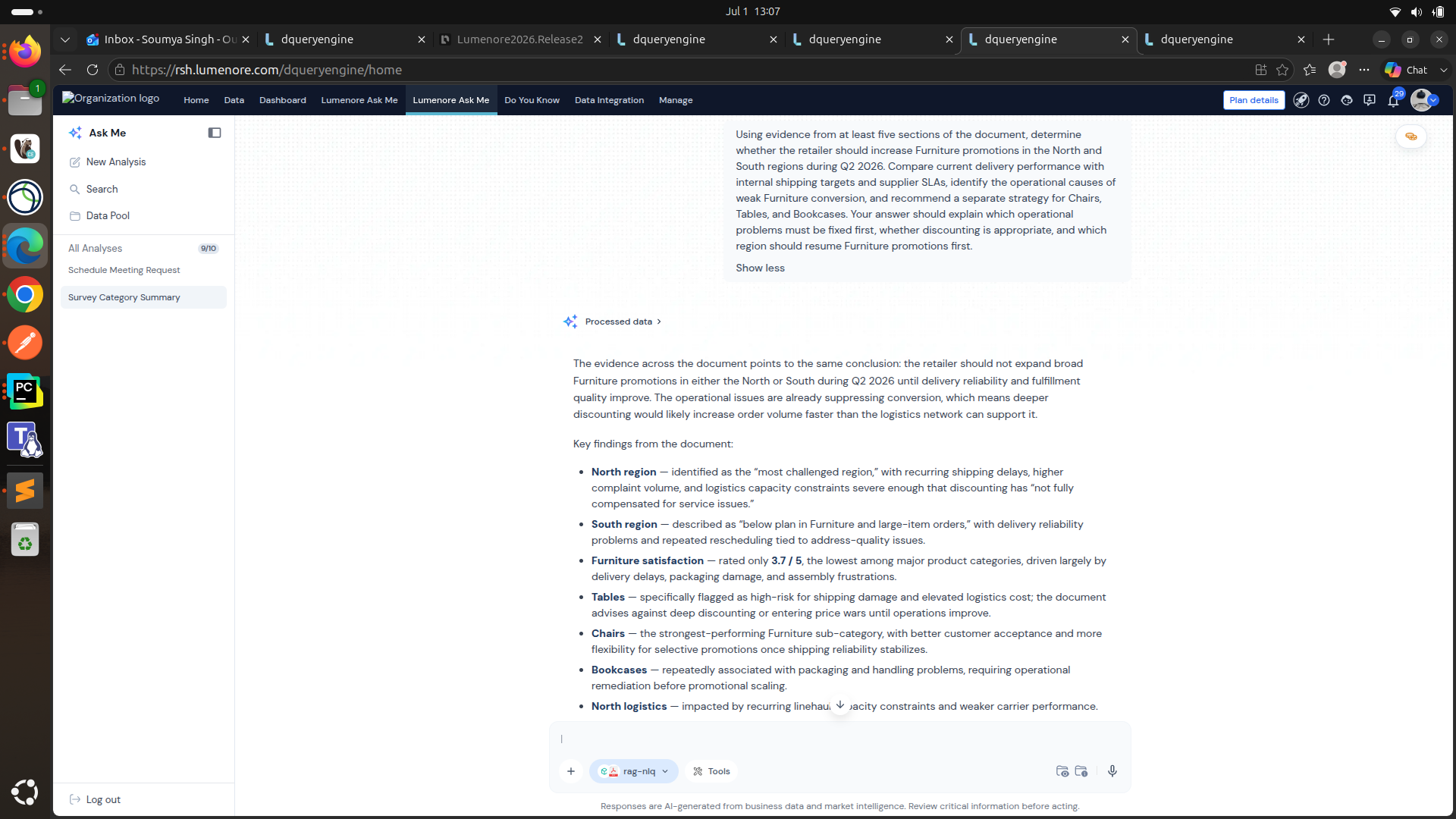
When you ask a question like “Are our current invoices aligned with our 2025 service agreements?”, Lumenore’s agents “read” the contract PDFs and “query” the financial database simultaneously. It brings the “hidden” 80% of your data into the light. This provides a 360-degree view that was previously impossible without weeks of manual labor. This is the future of AI agent development solutions, tools that understand the context of the written word, as well as the precision of a number.
For an agent to be effective, it needs access to the whole story. Most enterprises suffer from “Data Silos,” where the sales team has one truth, and the marketing team has another. Lumenore’s Data Magnet acts as a connective tissue.
It pulls from 100+ sources, from legacy ERP systems to modern cloud APIs, and unifies them into a single stream. This isn’t just about “collecting” data; it’s about “magnetizing” it. The Data Magnet cleans, validates, and prepares the information so that the AI agents have a “Source of Truth” that is actually true. Without this ingestion layer, an agent is only as smart as the silo it’s trapped in

As agents become more autonomous, the infrastructure supporting them must become more robust. This is where enterprise object store solutions for agentic AI workflows become critical.
An agent needs a “memory.” It needs to store the context of past decisions and the massive amounts of intermediate data it generates during its reasoning process. If an agent helps you solve a logistics problem in June, it should remember that context when a similar problem arises in January. Lumenore integrates with high-security object stores to ensure this data is governed and accessible only to those with the right permissions.
Privacy as a First-Class Citizen
In 2026, data privacy is not an afterthought; it is a requirement. For organizations in finance, healthcare, or government, sending data to a public cloud is often not an option.
This is why we offer Local LLM Integration. This allows you to run the full power of the Lumenore agentic ecosystem entirely on your own premises. Your data never leaves your “four walls.” You get the speed and intelligence of an AI agent with the security of a private server. This is how we ensure that innovation doesn’t come at the cost of compliance.

The question we hear most often is: What is the best solution for monitoring autonomous AI agents? In 2026, “Agentic Drift” is a real concern. An agent might slowly begin to prioritize the wrong metrics or misinterpret a new data source if it isn’t properly supervised.
Lumenore solves this through real-time “Guardrails.” We provide a monitoring layer that acts like a digital supervisor. It alerts you if an agent’s logic begins to deviate from established business rules or if it encounters a situation that requires human intervention.
Avoiding the Rogue Agent
Agency does not mean “unsupervised.” The best agentic systems are those that stay within the boundaries of human intent. Lumenore’s monitoring tools allow you to set the “scope of authority” for every agent. You can decide what they can see, what they can suggest, and what they can execute. This balance of autonomy and oversight is the hallmark of a mature agentic AI solution.
To truly appreciate the power of Agentic AI, we must look at how it transforms specific sectors. These aren’t just “tech demos”; they are fundamental shifts in how these industries operate.

Healthcare: Patient-First Analytics
In a high-pressure healthcare environment, doctors and administrators don’t have time to “drill down” into dashboards. They need answers. Lumenore’s agents monitor patient flow and resource allocation in real-time. If the agent detects a bottleneck in the emergency room, it doesn’t just show a red bar on the screen. It identifies the “Why,” perhaps a shortage of nurses on the third floor and suggests a staffing pivot. It moves healthcare from “tracking the crisis” to “preventing the crisis.”

Retail: Demand Forecasting at the Edge
For a global retailer, the supply chain is a complex web of variables. Lumenore’s Predictive Agents look at historical sales, current weather patterns, and even social media trends to forecast demand with surgical precision. If an agent sees a surge in demand for a specific product, it can automatically check the nearest warehouse inventory and draft a restocking order. This is the difference between a “Stock Out” and a “Sale.”
Many leaders ask, “How do I actually start?” The transition to an agentic enterprise doesn’t happen overnight. It is a journey.
Before you can deploy an agent, you must understand your data landscape. Use the Data Magnet to map out your silos. Identify where your “Hidden 80%” of unstructured data lives.
Agents work best when they have a clear mission. Instead of saying “Help me with Sales,” say “Find every instance where our discount rate exceeded 15% and explain why.”
Introduce Lumenore Ask Me to a small group of business leaders. Let them experience the freedom of asking questions in plain English. Once they see the speed of insight, the demand for an agency will grow naturally.
As you become comfortable with conversational analytics, begin deploying specialized sub-agents. Let the RCA Agent handles your weekly performance reviews. Instead of building board decks manually, use the platform to identify the "why" behind your data and generate the narratives you need for your next presentation.
The transition to Agentic AI is not just a technical upgrade; it is a shift in how we manage work. We are moving away from a world where humans must “serve” the data by spending hours in dashboards. We are moving toward a world where the data “serves” the human by providing ready-to-use insights and automated actions.
The Future of the “Data Team”
What happens to data analysts in this new world? They don’t disappear; they evolve. Instead of spending 80% of their time building manual reports, they spend their time “training the agents.” They become the architects of the reasoning loops, ensuring that the Master Agent understands the nuances of the business. The data team moves from being a “service desk” to being a “strategy engine.”
By 2027, the “Insight Bottleneck” will be a relic of the past. The companies that thrive will be those that empower their leaders with agents that can think, plan, and execute.
Lumenore is proud to be the partner helping businesses make this transition. We aren’t just building faster dashboards; we are building a more human way to work with data. We believe that intelligence should be accessible, conversational, and, above all, actionable.
The “Dashboard Era” was a necessary step, but the “Agentic Era” is where the real value begins. We invite you to step into a world where your questions are answered instantly. Your unstructured data is no longer a mystery, and your AI agents work as hard as you do.
The revolution is here. It is time to give your data to the agency it deserves.