
Healthcare Agentic Analytics
Transform Healthcare Analytics Into Intelligent Action.
Healthcare organizations already track patient flow, staffing and financial performance. The harder question is whether that information reaches the right person before the decision window closes.
Lumenore connects healthcare data, predictive intelligence and Agentic Analytics so clinical, operational and financial leaders can understand what is happening, anticipate what happens next, and act before small gaps become larger problems.
- 14% → 9%30-day readmission in behavioral healthcare
- 83%Staffing-prediction accuracy
- 25–35%Reduction in patient wait time
- 22%Reduction in maternal mortality in public health
Customer results from Lumenore healthcare implementations. Results are implementation-specific and are not guaranteed outcomes.
Trusted by Healthcare and Public-Health Organizations





Start With the Healthcare Reality
Healthcare Leaders Are Being Asked to Decide Faster, With Less Room for Error.
Healthcare organizations are managing rising demand, workforce pressure, financial constraints and growing administrative complexity, often at the same time. The challenge is no longer access to information.
- What changed?
- Why did it happen?
- What is likely to happen next?
- Who or what needs attention?
- What should we do about it, and how fast?
Workforce Pressure
Staffing remains one of healthcare’s largest cost and operational challenges. Hospitals are balancing shortages, burnout, fluctuating patient volumes and the need to protect quality of care.
Financial Pressure
Rising labor and operating expenses, reimbursement complexity, claims denials and administrative burden are forcing organizations to spot inefficiency and financial risk earlier.
Fragmented Decisions
Clinical, operational, workforce and financial information often lives in separate applications and separate teams, making the full picture behind an issue hard to see.
Growing Decision Complexity
Leaders increasingly need to combine historical performance, real-time signals, predictive intelligence and organizational context before deciding what to do next.
Care Coordination Gaps
The patient or member journey often spans multiple providers, services and data sources, making prioritization and follow-through difficult.
Trust Requirements
AI-assisted healthcare decisions require explainability, permissions, human oversight and appropriate controls.
The Pressure, in Numbers
- ~60%of total hospital expenses go toward workforce, while workforce costs rose 5.6% in 2025
- $43B+spent by hospitals in 2025 pursuing insurer payments for care already delivered
- 7.5%growth in total hospital expenses in 2025, more than double the growth in hospital prices
About These Figures
Workforce share, insurer-payment pursuit costs, and hospital-expense growth are reported by the American Hospital Association.
View Costs of Caring, 2026

The Decision Gap
More Data. More Dashboards.
Still No Agent Doing the Analysis.
Traditional analytics helps healthcare organizations understand what already happened. Many healthcare decisions need more than that.
A dashboard can tell a hospital that
Patient wait times increased last month.
True, and not yet useful. The questions that actually matter come next.
- 01
Where are wait times increasing?
- 02
What is driving the change?
- 03
Is the problem staffing, patient volume, scheduling or capacity?
- 04
Where is the same issue likely to appear next?
- 05
What should the operations team focus on first?
Decision Gateway
Which Healthcare Decision Are You Trying to Improve?
Different healthcare leaders arrive at the same data with very different questions. Choose the decision area that matters most.
For: Clinical leaders · Care-management teams · Population-health leaders
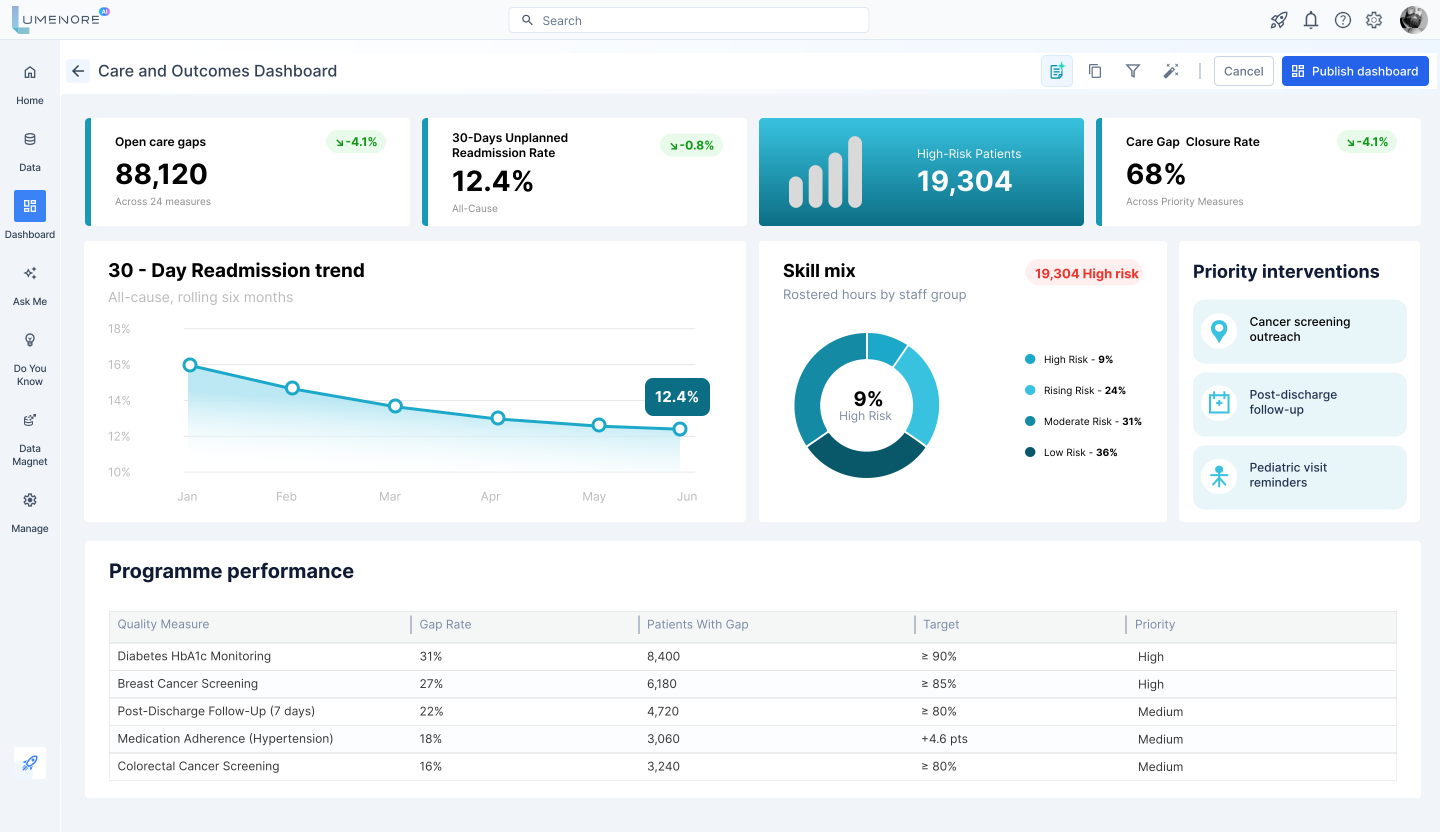
Which Patients Need Attention, Why, and Where Should We Focus First?
Identify patients and members who may need attention, understand what is influencing outcomes, and help teams prioritize the right interventions.
- Risk stratification
- Care gaps
- Outcome drivers
- Intervention priority
- Readmission
For: COOs · Hospital administrators · Operations leaders
Where Are Delays or Capacity Constraints Emerging, and What Is Driving Them?
Understand patient flow, utilization, scheduling and capacity across departments so operational teams can spot bottlenecks and respond earlier.
- Patient flow
- Utilization
- Scheduling
- Capacity
- Length of stay
- Bottlenecks

For: COOs · Nursing leaders · Workforce teams · Hospital administrators
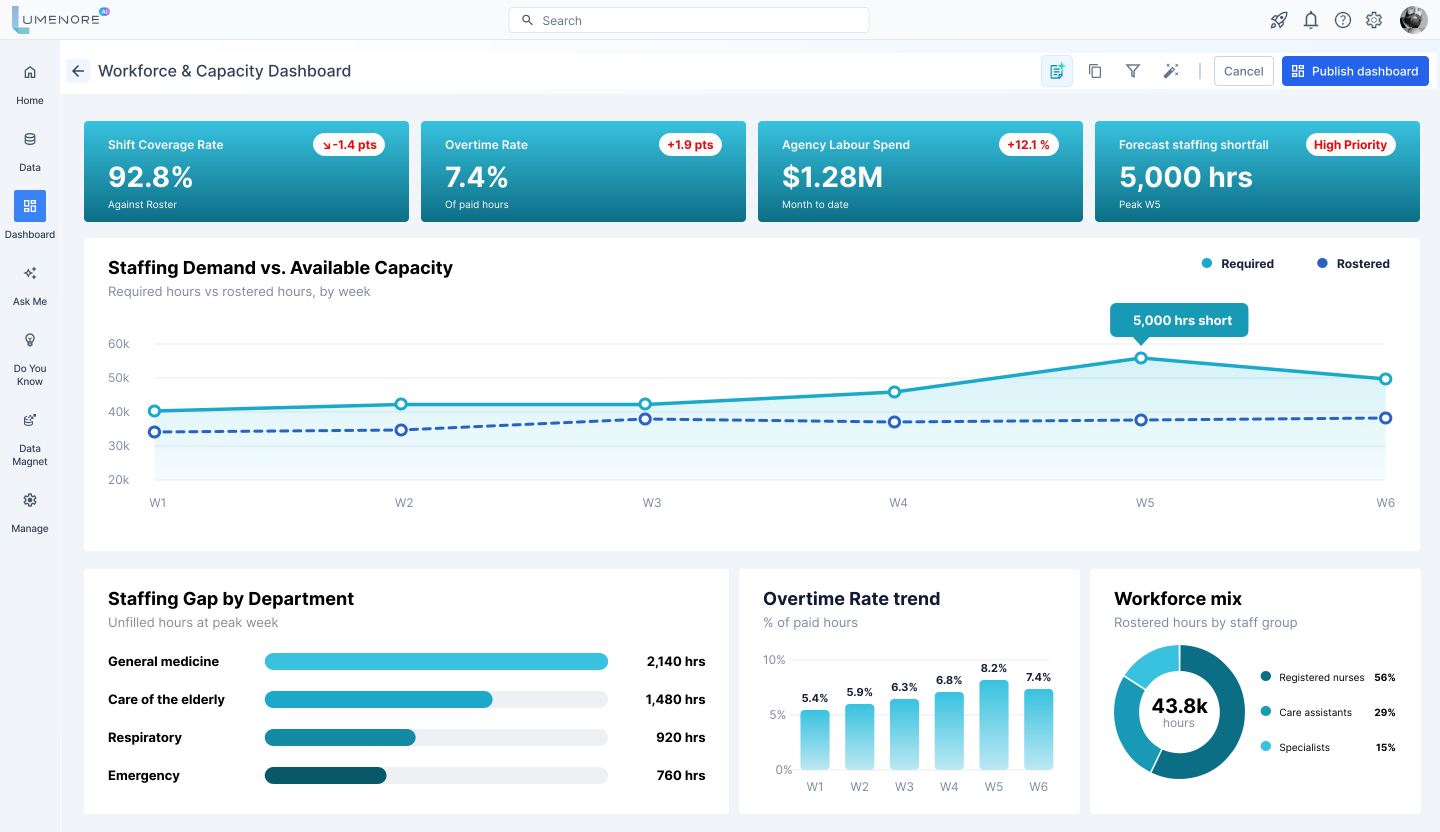
Where Will Patient Demand Exceed Available Capacity, and How Should We Respond?
Combine patient demand, staffing, scheduling and workforce information to see where capacity and demand may become misaligned.
- Demand forecasting
- Staffing
- Shift planning
- Skill mix
- Overtime
- Burnout risk
For: CFOs · Finance leaders · Revenue-cycle and operations teams
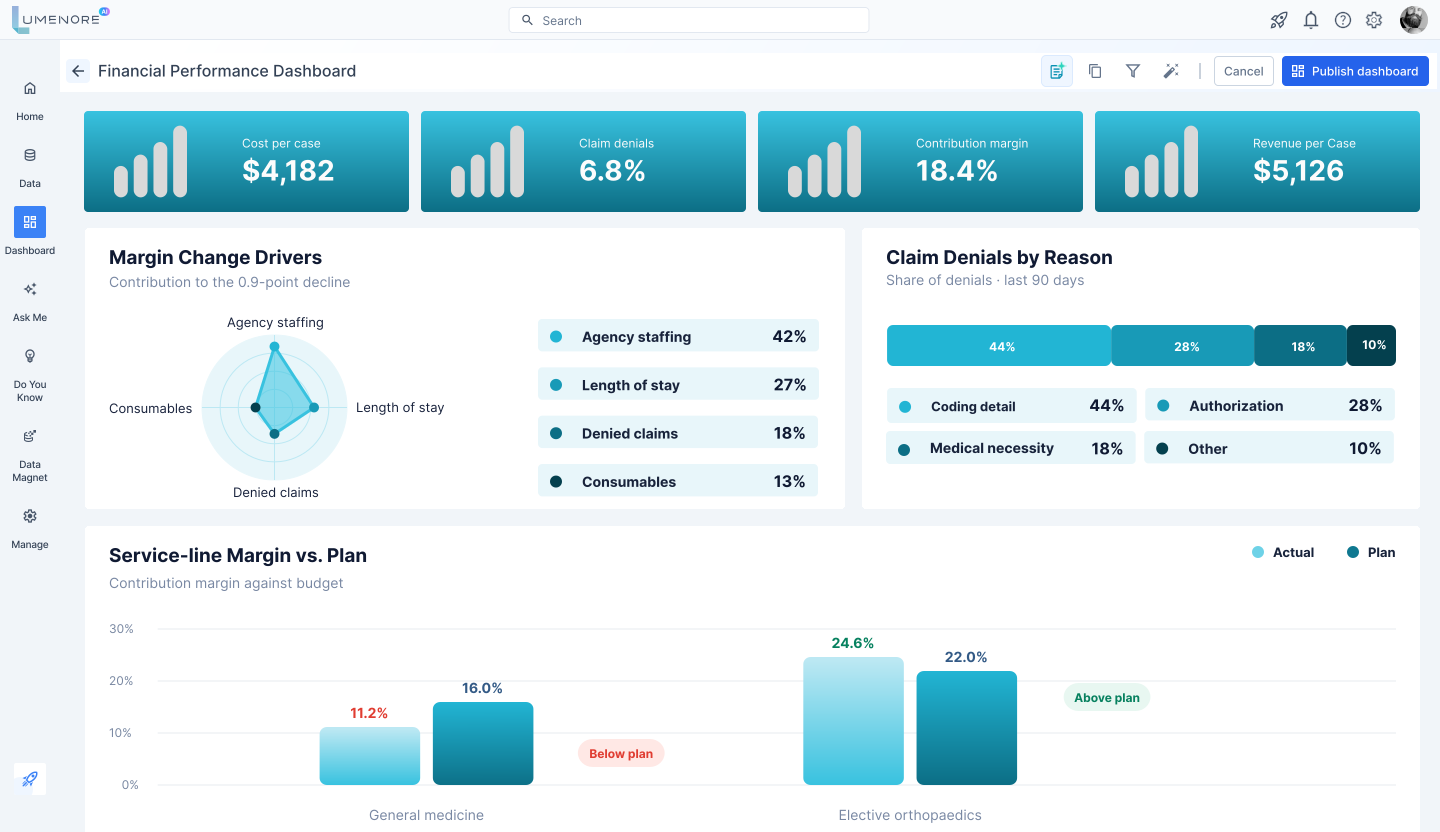
Where Is Financial Performance Being Lost, and What Is Causing It?
Connect financial and operational signals to identify cost pressures, utilization gaps, revenue opportunities and performance drivers.
- Cost per case
- Claims denials
- Revenue cycle
- Payer mix
- Margin drivers
- Utilization
For: Population-health leaders · Public-health organizations · Behavioral-health teams
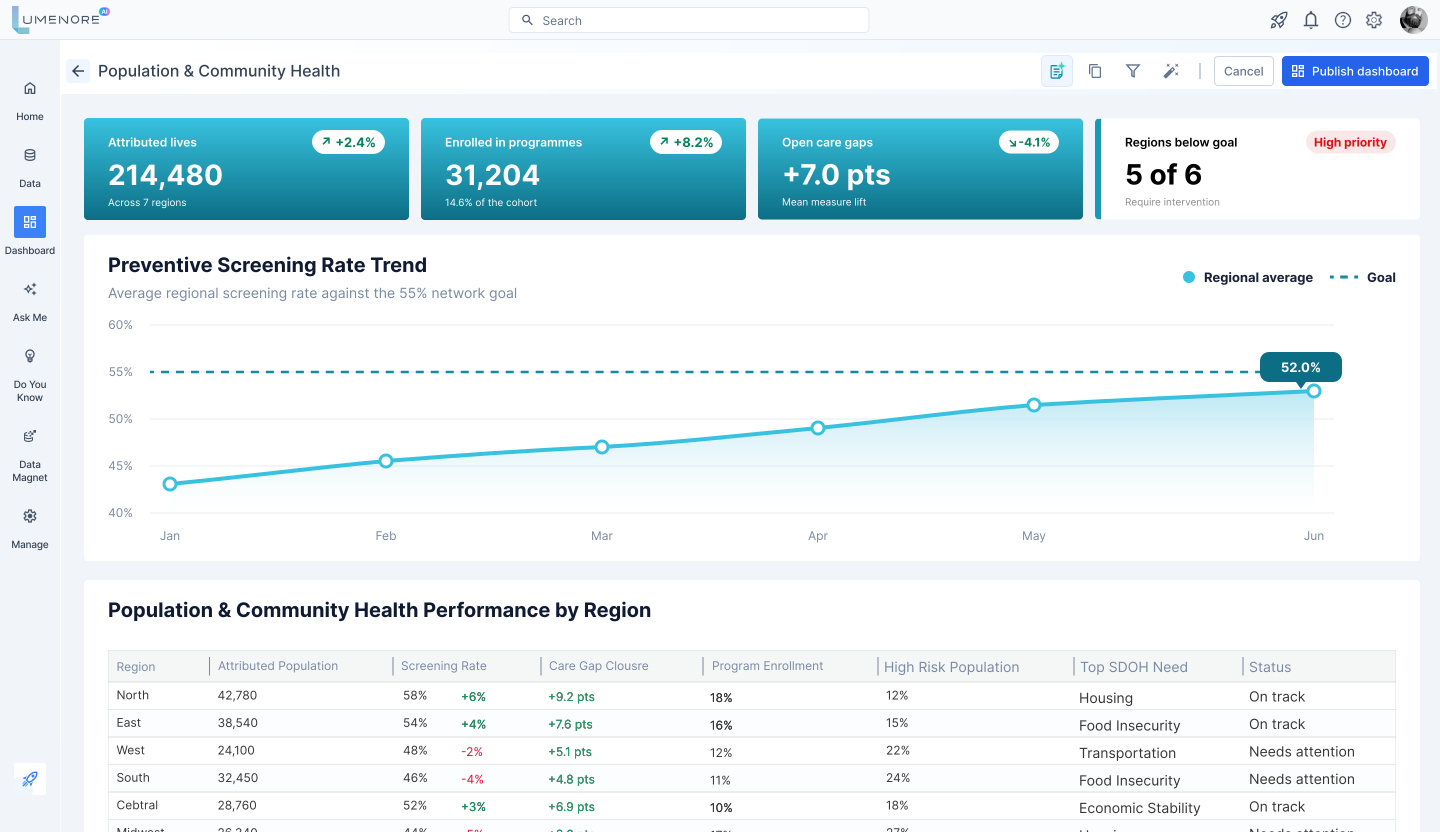
Which Populations Require Attention, and Where Should We Intervene?
Understand risk across populations, cohorts, programs and geographies, and determine where attention and intervention have the greatest impact.
- Population risk
- Cohorts
- Program performance
- Geographic variation
- Social determinants
For: CIOs · CDOs · Data leaders and analytics teams
How Do We Safely Turn Fragmented Healthcare Data Into Trusted Intelligence?
Build a connected, governed data foundation that lets analytics and AI work across healthcare information without creating another isolated intelligence layer.
- Data integration
- Governance
- Permissions
- Semantic context
- Self-service
- Traceability
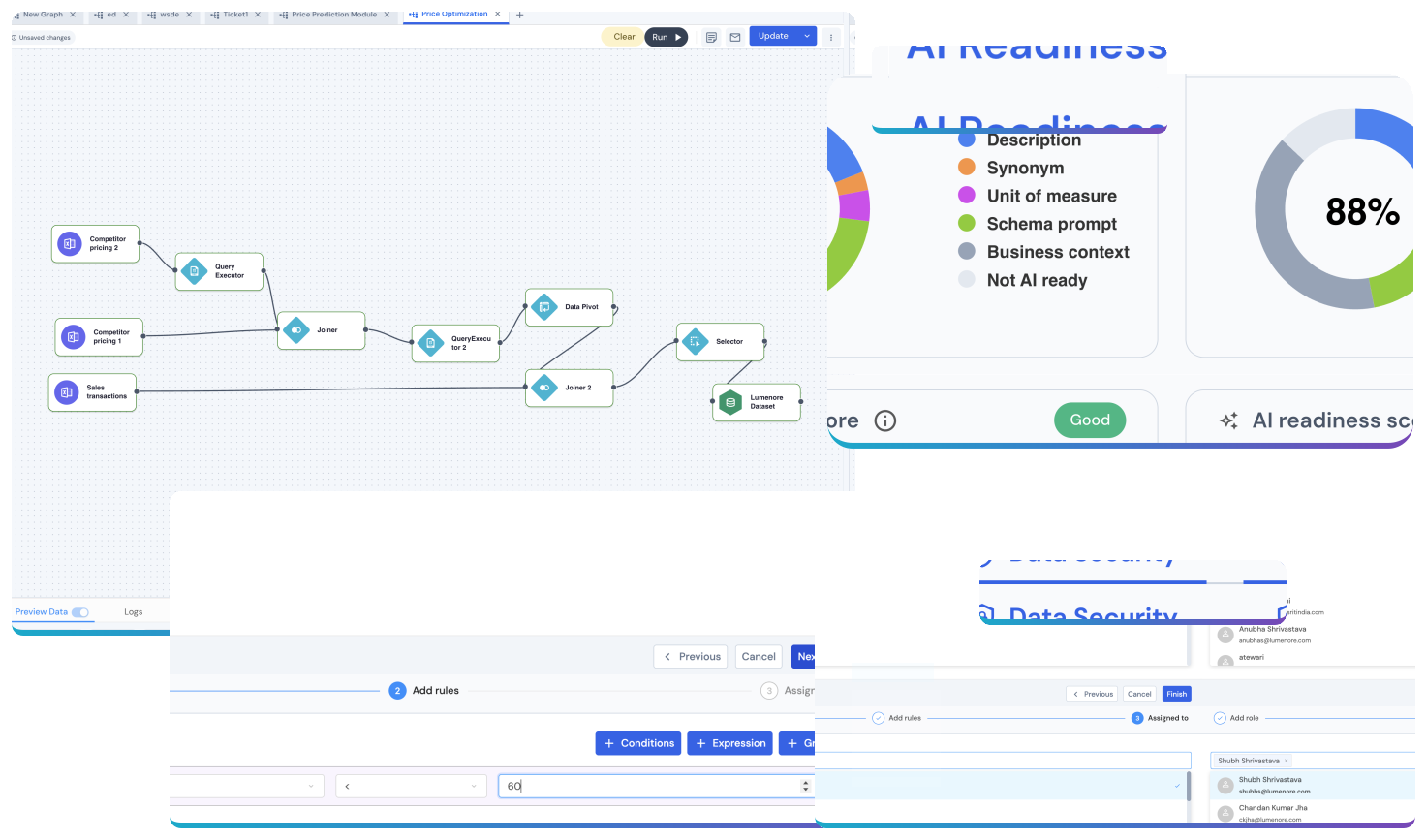
See It in Lumenore
From the Healthcare Question to the Next Action.
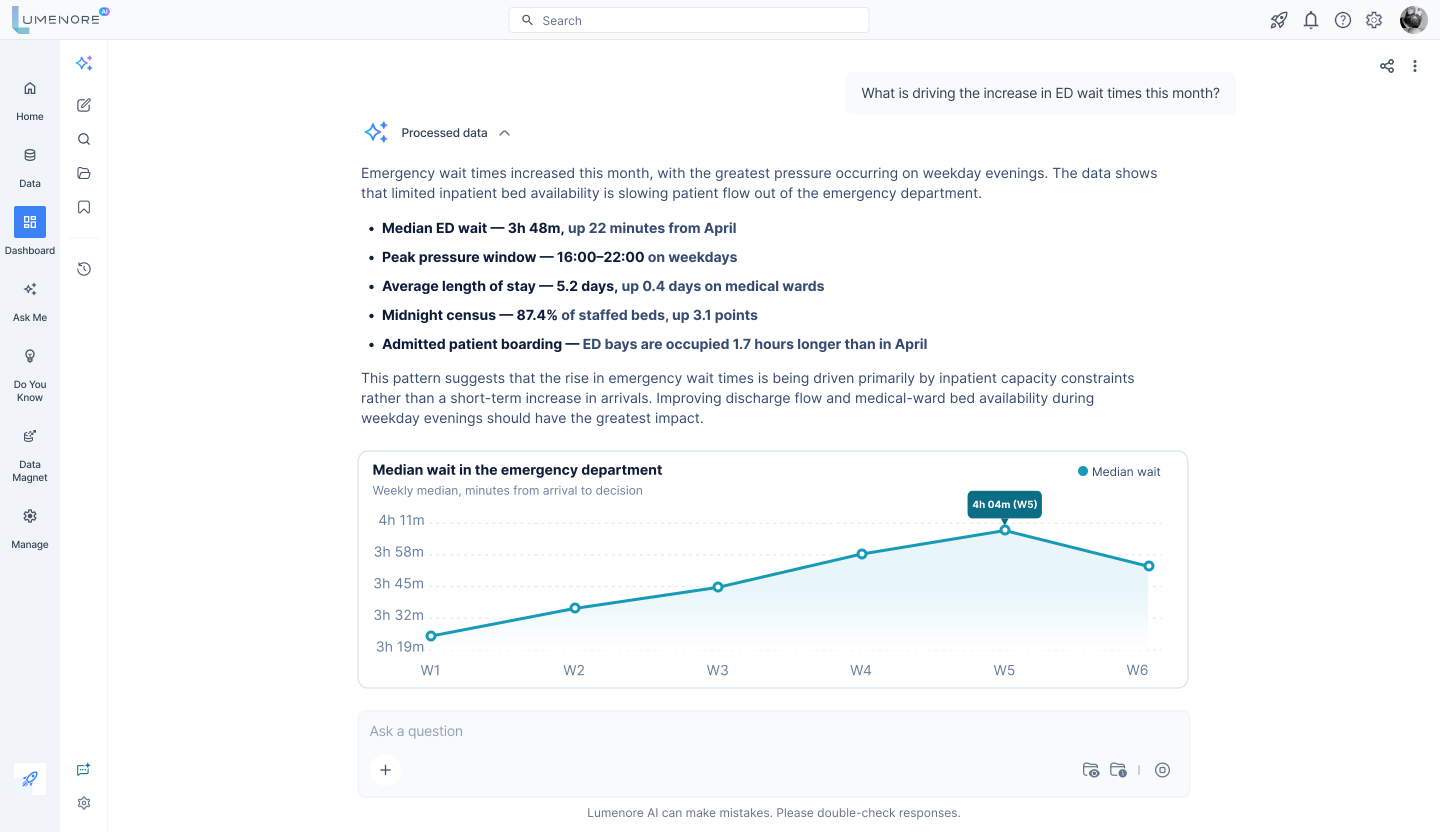
Ask the Healthcare Question Directly.
Clinical, operational and financial leaders explore performance in natural language, spot anomalies and investigate the factors behind an outcome without waiting for another report.
- Natural-language questions over approved healthcare data
- Anomalies surfaced against the context around them
- Every answer traceable back to its supporting information
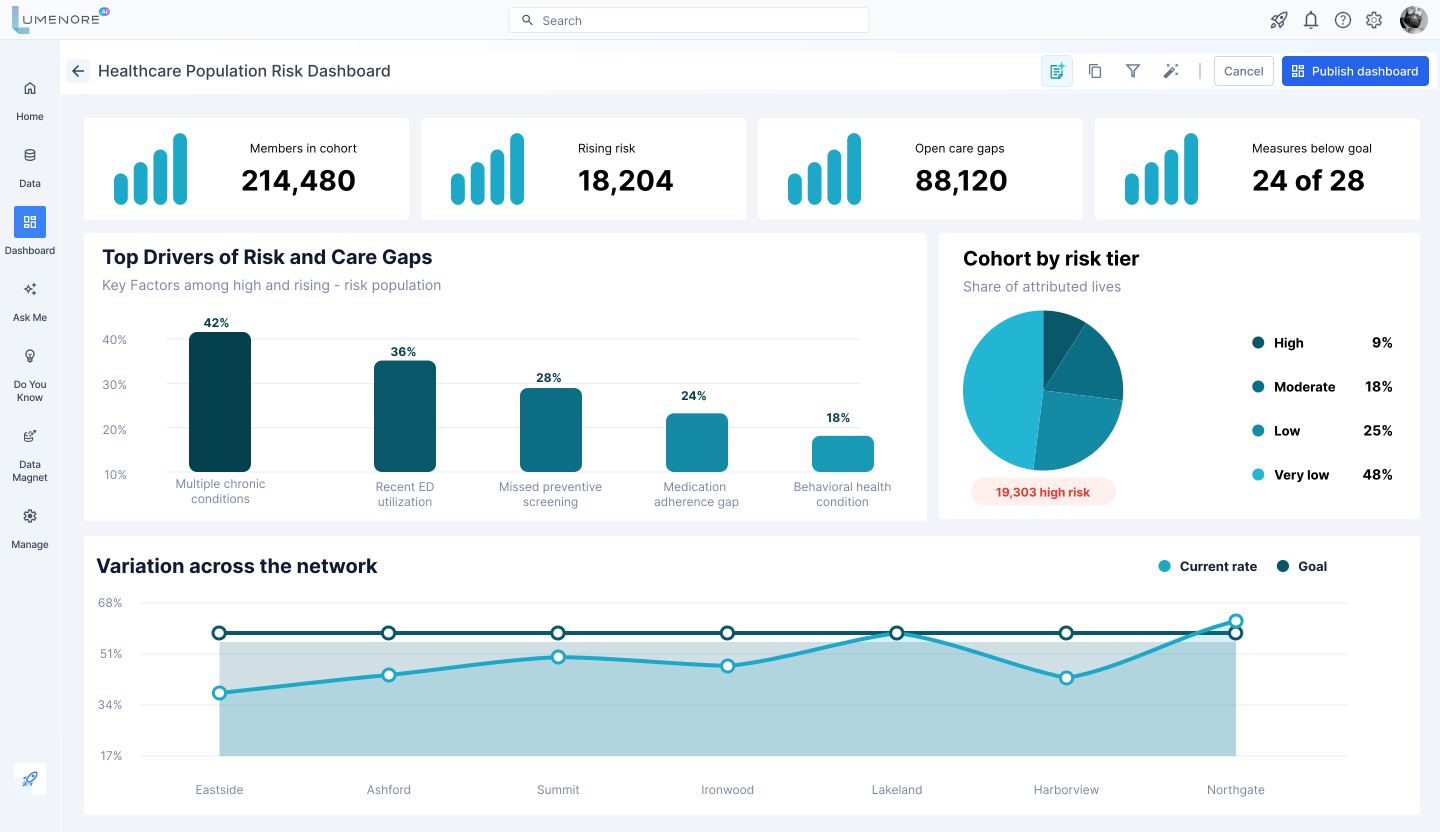
See Who Needs Attention, and Why.
Approved patient, utilization, care-management and population data is used to identify patterns and higher-risk groups, with the supporting context care teams need to decide the appropriate next step.
- Risk stratification across cohorts, programs and geographies
- Care gaps surfaced alongside the factors influencing them
- Consequential judgment stays with the clinical leader

Close the Gap Before It Opens.
Bring patient-volume, workforce, HR and scheduling information together to identify demand patterns and anticipate potential staffing gaps early enough to review allocation before patient flow is affected.
- Projected demand compared against staffed capacity
- Emerging capacity and length-of-stay risk flagged early
- Priorities routed to the team that owns the decision
Introducing Lumenore
Turn a Healthcare Question Into
Agentic Action.
Lumenore helps healthcare organizations build a continuous path from fragmented data to better-informed decisions.
Connect
Bring together relevant clinical, operational, workforce, financial and enterprise information from across the healthcare ecosystem.
Goal
Start with the healthcare question or decision, not a predefined dashboard workflow.
Orchestrate
The Master Agent interprets intent and routes analytical work to the most appropriate specialized agent or agents.
Understand
Explore performance, ask questions in natural language, spot anomalies and investigate the factors behind an outcome.
Anticipate
Use predictive analytics and machine learning to identify emerging risks, demand patterns and likely outcomes earlier.
Recommend
Bring the most relevant information, patterns and priorities to the people responsible for the decision.
Decide
Keep consequential healthcare judgment with the appropriate clinical, operational, financial or population-health leader.
Act
Use insights, alerts and connected experiences to help teams respond earlier and focus attention where it matters.
Learn
Measure outcomes over time and use the results to continuously improve future decisions.
Scroll the stages, tap a card, or pick a circle

Make Better Healthcare Decisions, Earlier.
Connect the data behind your most critical healthcare decisions and uncover what needs attention next.
Healthcare Ecosystems
Agentic Analytics, Built Around Different Healthcare Environments.
The decisions are different across healthcare. The intelligence foundation does not have to be.
-
01
Providers & Health Systems
Where are clinical and operational pressures emerging across the health system?
- Patient flow
- Workforce planning
- Capacity management
- Clinical outcomes
- Revenue-cycle intelligence
- Quality improvement
-
02
Payers & Health Plans
Which members or populations require attention, and what factors are driving the risk?
- Population risk
- Utilization
- Care gaps
- Member experience
- Cost of care
- Quality performance
-
03
Behavioral & Community Health
Who is at risk of returning to crisis care, and where should teams intervene earlier?
- Risk stratification
- Recidivism
- Crisis utilization
- Care coordination
- Intervention management
- Outcome measurement
-
04
Public & Population Health
Which populations, programs or regions require attention now?
- Population monitoring
- Program performance
- Geographic variation
- Resource allocation
- Emerging trends
- Intervention tracking
Customer Proof
From Healthcare Questions to Measurable Outcomes.
-

Behavioral Healthcare
- 14% → 9%30-day readmission
- $2M+annual savings
Lumenore helped behavioral healthcare teams identify members at higher risk of returning to care, uncover care gaps and prioritize earlier intervention.
Explore the story -

Healthcare Workforce
- 83%staffing-prediction accuracy
- 25–35%reduction in patient wait time
Lumenore helped healthcare leaders connect patient demand, workforce and scheduling data to anticipate staffing gaps and make earlier allocation decisions.
Explore the story -

Multispecialty Hospital Chain
- 10–12%reduction in average length of stay
- 17–22%less manual reporting effort
Lumenore helped hospital teams connect patient-flow and operational data to identify emerging bottlenecks, improve resource planning and support more efficient care delivery.
Explore the story -

Pediatric Therapy
- 37–40%reduction in manual effort
- 90%improvement in therapy-goal visibility
Lumenore helped pediatric therapy teams improve visibility into patient goals and progress while reducing the manual effort involved in managing therapy information.
Explore the story -

Public Health
- 22%reduction in maternal mortality
- 18%increase in immunization coverage
Lumenore helped public health teams bring population and program data together to identify high-risk groups, prioritize interventions and improve visibility across diverse regions.
Explore the story
Technology Behind the Experience
The Agentic Analytics Behind Better Healthcare Decisions.
Move from a healthcare question to governed analysis, supporting evidence and the next decision in one connected experience.
Conversational Intelligence
Let healthcare leaders and teams ask business questions in natural language instead of waiting for another report.
AI Agents
Use specialized AI assistance for analytical work such as exploring data, investigating root causes, generating visualizations and supporting predictive analysis.
Predictive Intelligence
Use historical and current information to forecast demand, risk and likely outcomes.
Root-Cause Analysis
Move beyond flagging that a KPI changed, toward investigating the factors behind the change.
Enterprise Data Integration
Bring together information distributed across clinical, financial, workforce and operational systems.
Dashboards & Visual Analytics
Give executives, analysts and operational teams persistent visibility into the KPIs and trends they need to manage.
MCP & Connected Intelligence
Extend conversational intelligence to appropriately connected enterprise data, tools and systems, so users can explore beyond a single isolated dataset.
Trusted Agentic Intelligence
Agentic Intelligence for Healthcare Must Be Trusted Intelligence.
Healthcare decisions cannot depend on unexplained AI outputs. The intelligence layer must respect organizational access, provide context behind its responses and keep people appropriately involved in consequential decisions.
Governed Access
Intelligence should respect the user’s permissions and approved data access.
Explainable Decisions
Users should be able to understand the information and factors behind an insight or recommendation.
Human Oversight
AI should augment healthcare professionals and operational leaders, not remove appropriate human judgment from consequential decisions.
Traceability
Teams should be able to trace where an important insight originated and investigate the supporting information.
Enterprise Security
Healthcare information requires appropriate security, privacy and deployment controls.


Put Agentic Analytics Behind Your Next
Healthcare Decision.
Turn fragmented healthcare data into clearer insight, earlier action and better outcomes.