Webinar
How Embedded Analytics is Evolving into Intelligent Action View Now

Agentic HR Analytics

Agentic HR Analytics for Smarter Workforce Decisions

Ask your workforce questions in plain language and let Lumenore Ask Me do the digging. Backed by specialized AI agents and governed HR analytics, it helps you explore KPIs, understand what is driving change, and spot emerging patterns.

The result: HR leaders move from static reporting to faster, better informed decisions, with the analysis staying reviewable at every step.

Ask MeHR workspace
HR leader

Why did attrition rise in Engineering last quarter?

Ask Me

Engineering attrition rose 4.6 points. Tenure under two years, two manager changes, and compensation band drift account for most of the movement.

HR leader

Which teams or roles should we investigate first?

Ask Me

Platform and Data Engineering explain 58% of the change. Nine roles in two locations deserve a closer review.

Governed workforce dataHuman decision control

The Workforce Context Gap

People Outcomes Rarely Live Inside
a Single HR System

An attrition spike might trace back to tenure, manager changes, compensation, workload, or engagement. Lumenore brings workforce and business data together so HR can investigate the fuller context behind a change.

HR SignalThen Investigate Questions Such AsRelevant Data
Attrition IncreasedIs the change concentrated by team, manager, tenure, role, location, compensation band, or workload pattern?HRIS, payroll, engagement
Time-to-Fill LengthenedWhich roles, sourcing channels, approval steps, or locations account for the slowdown?ATS, workflow, location
Labor Cost RoseWhich departments, projects, shifts, overtime patterns, or headcount changes are driving the increase?Payroll, finance, operations
Engagement DeclinedWhich teams changed most, and how do workload, manager patterns, mobility, or organizational changes compare?Engagement, HRIS, mobility
Skills Gaps WidenedWhich roles or business initiatives are creating new capability demand, and where is training closing the gap?LMS, performance, planning

Connect the HR signal to the business context around it before deciding where attention belongs.

Category Definition

What Is HR Analytics?

HR analytics, also known as people analytics or workforce analytics, uses workforce and business data to understand employee and organizational performance.

Modern HR analytics software combines trusted metrics, self-service exploration, predictive techniques, and AI-assisted analysis, so teams are not stuck waiting on historical reports. They can respond sooner instead.

  1. 01What Happened?

    Monitor workforce KPIs and performance.

  2. 02Why Did It Happen?

    Investigate variances, drivers, correlations, and contributing factors.

  3. 03What Is Changing?

    Surface trends, anomalies, and emerging patterns.

  4. 04What Might Happen Next?

    Use forecasting and predictive techniques where the data supports them.

  5. 05Where Should We Focus?

    Prioritize the teams, roles, locations, or issues that merit deeper investigation.

Monitor, ask, explain, anticipate, and prioritize while HR leaders keep the decision.

One Conversational Experience

Start With the HR Question, Not the Report

HR users should not have to decide upfront whether a question calls for a KPI lookup, a root-cause investigation, a forecast, or a new visualization. Ask Me reads the intent and routes the request to whichever analytical capability fits the question and the available data best.

  1. Hub

    Ask Me Master Agent

    Interprets the workforce question and coordinates the analysis behind one conversation.

  2. 01

    Natural Language Agent

    Interprets business questions and returns relevant metrics, insights, and visual responses.

  3. 02

    Root Cause Analysis Agent

    Helps investigate why key metrics changed by exploring contributing dimensions and drivers.

  4. 03

    Data Science Agent

    Applies advanced techniques to identify patterns, trends, anomalies, and forecasts.

  5. 04

    Visualization Agent

    Refines the visual response so patterns and comparisons are easier to understand.

Ask Me keeps the analytical complexity behind the scenes, so HR teams stay focused on the workforce decision in front of them.

Ask Your Workforce a Question

One Conversation. Several Kinds of Analysis.

Each follow-up preserves the context of the last one, so the experience feels like analysis unfolding rather than five unrelated searches.

Ask MeGoverned workforce KPIs

Retrieves and compares governed workforce KPIs across the period you asked about.

Headcount10,480+2.4%
Attrition14.2%+1.8 pts
Time to fill47 days+6 days

Illustrative analysis. Results depend on connected data, governance, and context.

From Monitoring to Better Workforce Decisions

There Is a Difference Between Watching the Numbers and Knowing Where to Focus

Move from a recurring metric to the follow-up question, the investigation, the forward-looking view, and an evidence-backed priority.

  1. 01

    Monitor

    Keep recurring workforce metrics visible through dashboards, KPIs, filters, and alerts.

  2. 02

    Ask

    Explore the next business question through natural-language conversational analytics.

  3. 03

    Explain

    Investigate contributing factors through drill-down, correlation, and trend analysis.

  4. 04

    Anticipate

    Understand patterns and possible direction through forecasting and what-if exploration.

  5. 05

    Decide

    Bring metrics, context, visuals, and findings together for human decision-making.

Monitor, ask, explain, and anticipate while HR remains accountable for the decision.

Built for the People Who Make Workforce Decisions

Same Workforce Data.
Very Different Questions.

Choose a role to see the decisions and analytical context that matter most.

HR leaders reviewing workforce health and deciding where organizational attention belongs
Workforce Decision ViewConnect people performance with the business context behind it.

CHRO, CPO, and VP HR

Where Is Workforce Health Changing, and Where Should Leadership Focus?

Get a strategic view of workforce health, risk, capability, and cost, then investigate why it moved.

  • Workforce health
  • Attrition risk
  • Capability and skills
  • Workforce cost
  • Executive KPIs
  • Leadership reporting
Human oversight stays central: Lumenore supports analysis and decision support. Appropriate human judgment remains essential for consequential hiring, promotion, compensation, and termination decisions.

HR Analytics Across the People Organization

Which Workforce Decision Are You Actually Trying to Improve?

Every HR function works from the same workforce foundation, but each one is making different decisions. These six areas organize the analysis around them.

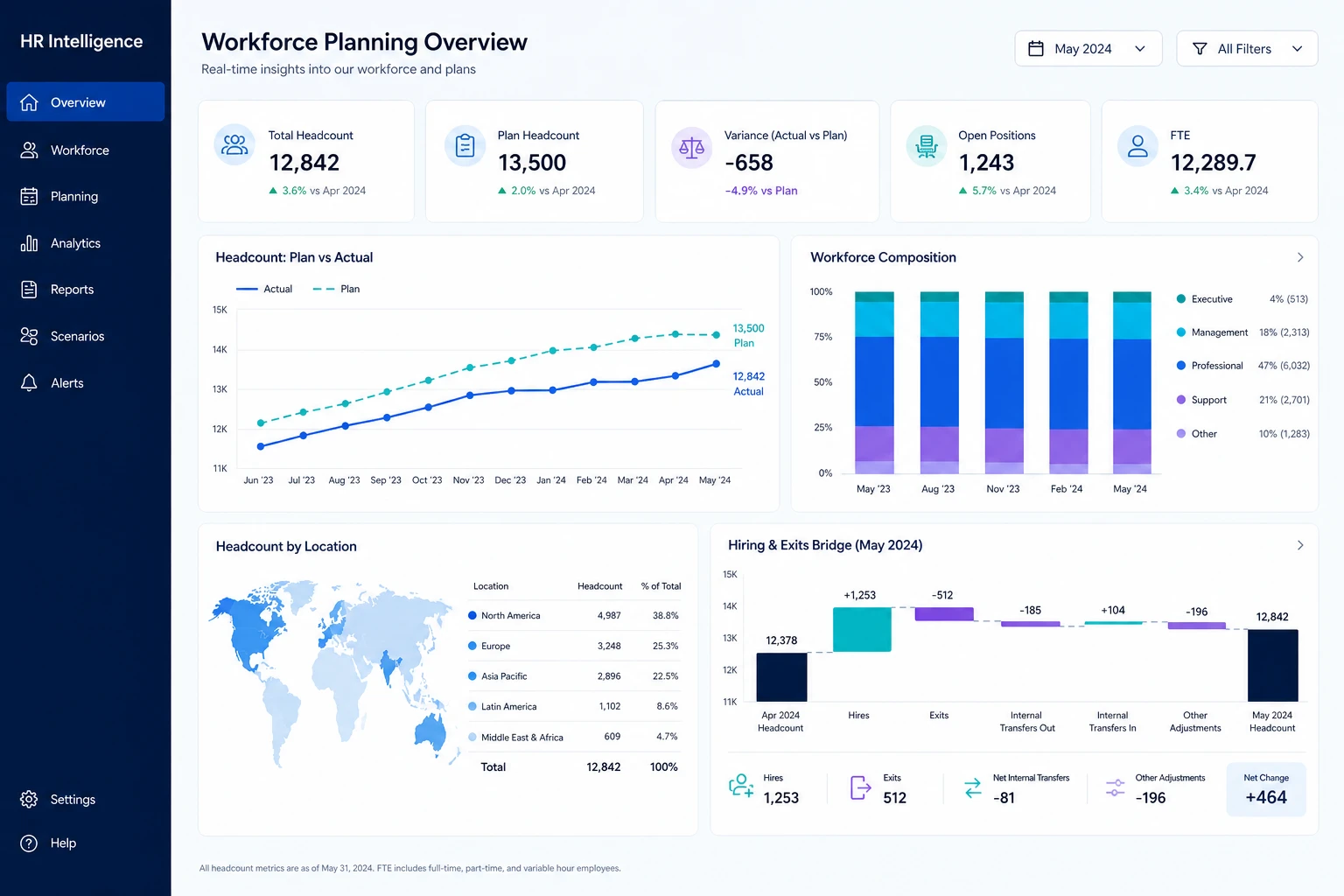
  • Workforce Planning

    Do we have the people and skills required for the plan?

    Headcount versus plan, capacity, workforce composition, skills coverage, hiring demand, and location trends.

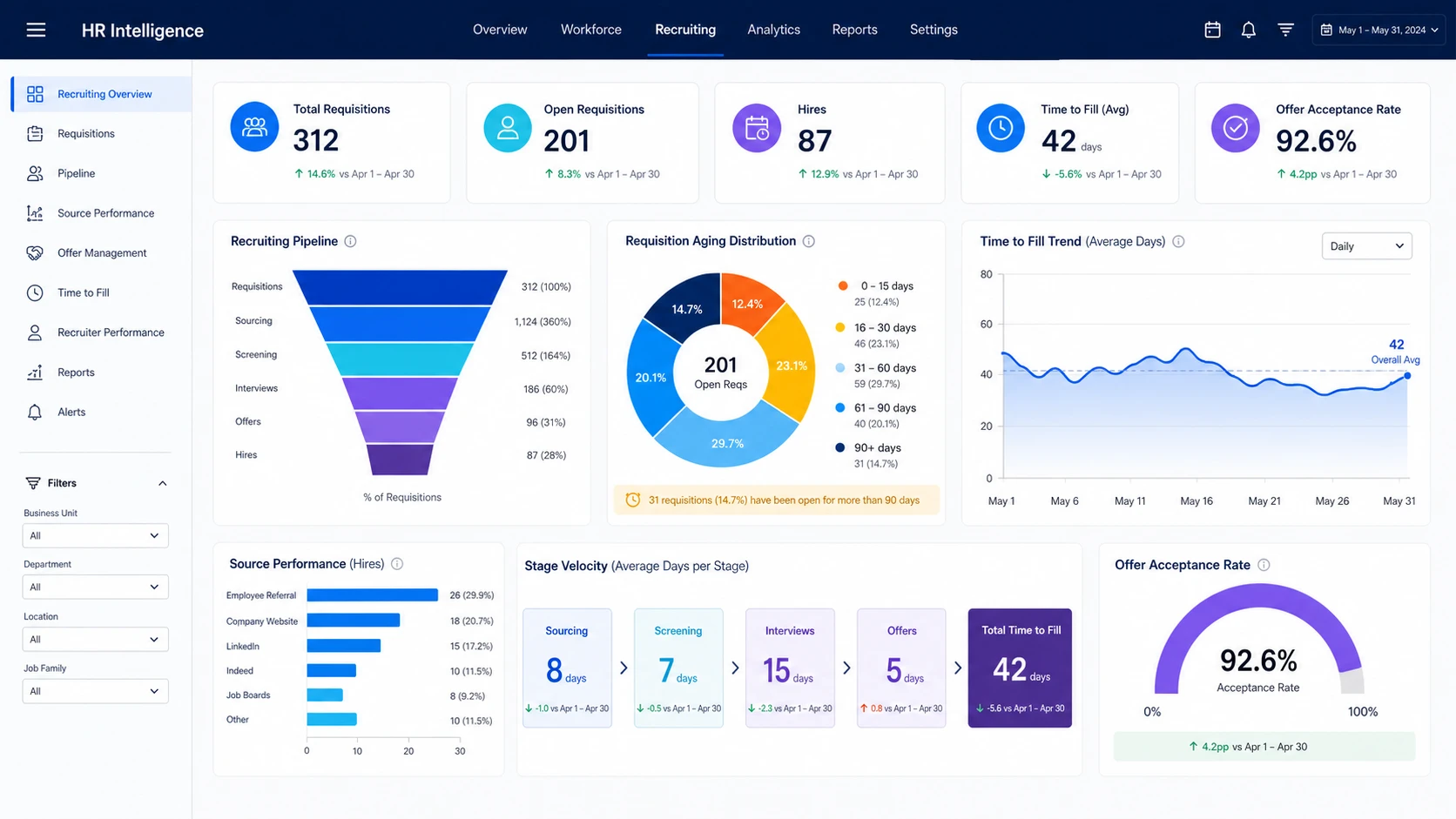
  • Talent Acquisition

    Where is hiring slowing down, and which sources are working?

    Time-to-fill, requisition aging, funnel conversion, source of hire, offer acceptance, and hiring velocity.

  • Engagement and Retention

    Where is attrition or disengagement emerging?

    Attrition, regrettable turnover, tenure, manager and team patterns, engagement trends, and exit themes.

  • Performance and Skills

    Which talent investments are improving capability?

    Performance distribution, skills gaps, training completion, learning impact, mobility, and succession indicators.

  • Compensation and Benefits

    Where are pay, benefits, or workforce costs drifting from plan?

    Compensation benchmarking, pay distribution, total rewards cost, benefits utilization, overtime, and merit cycles.

  • People Analytics and HRIS

    Can HR trust the metrics and answer without another report?

    Data reconciliation, shared KPI definitions, reporting consistency, cross-system analysis, and governed self-service.

Numbers and the Employee Voice

Not Every HR Question Can Be Answered From an HRIS Field

Exit interview notes, survey comments, performance narratives, and policy documents all add context that pure metrics miss. Ask Me can analyze structured data alongside this unstructured content in one connected analysis.

  • HRIS
  • Payroll
  • ATS and LMS
  • Engagement
  • Exit Notes
  • Policies
Structured Workforce DataHRIS and payroll
ATS, LMS, and performance
Workforce planning files
Documents and ContextExit interviews
Survey comments
Policies and guidelines
One Ask Me Analysis

What themes appear most often in exits from high-turnover teams?

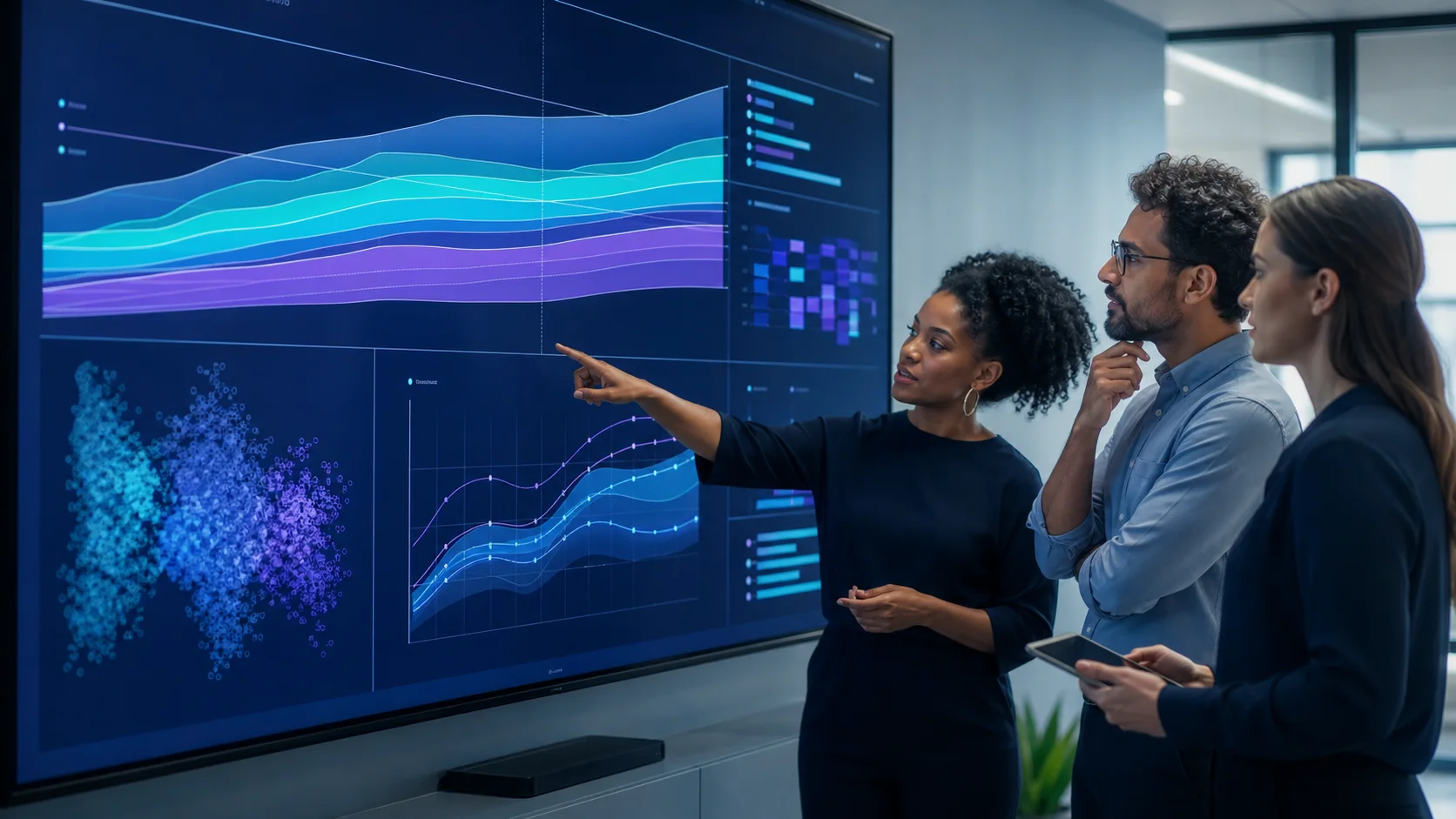
People analytics team reviewing workforce trends and future staffing scenarios
Predictive HR AnalyticsSee workforce risk and change earlier, while there is still time to investigate.

Predictive HR Analytics

See Risk and Change Earlier

Many workforce decisions get made only after attrition has climbed, hiring plans have slipped, or costs have drifted off plan. Predictive techniques help teams spot patterns and likely direction sooner, where the history supports the analysis.

  • Track headcount, attrition, hiring, engagement, and cost trends over time.
  • Use regression and forecasting to explore future staffing patterns.
  • Flag unusual changes or outliers that deserve a closer look.
  • Run correlation analysis between outcomes and contributing factors.
  • Compare supported what-if scenarios against alternative assumptions.
  • Prioritize the teams, roles, locations, or patterns that merit review.
ForecastingRegressionTrend AnalysisOutlier DetectionCorrelationWhat-If Analysis

Trusted Agentic Analytics

Sensitive Workforce Decisions Deserve More Than a Black Box

HR analytics touches employee privacy, compensation, and performance, so trust matters as much as speed. Lumenore combines AI-assisted analysis with enterprise controls, letting self-service expand without losing governance or human accountability.

HR privacy, legal, and analytics leaders reviewing fairness and source evidence
Evidence Before ActionReview sources and findings before a consequential people decision.
Global IT services people operations team reviewing unified workforce reporting

Customer Proof

50% Less Manual Reporting Effort for a Global IT Services Provider

A provider with more than 10,000 employees across 20-plus countries unified its HR data, automated reporting, rolled out workforce dashboards with attrition prediction, and added conversational analytics for faster access to insight.

  • 50%Reduction in manual reporting effort
  • ProactiveAttrition-risk visibility through predictive analytics
  • Real-TimeWorkforce insights for faster leadership decisions
Read the Global IT Services Customer Story

Why Lumenore

Why Lumenore for HR Analytics?

  • 01

    Start With the Business Question

    Give HR users a conversational path into workforce data through Ask Me.

  • 02

    Go Deeper When You Need To

    Specialized agents handle natural-language exploration, root-cause analysis, visualization, and advanced analytics.

  • 03

    Connect Workforce and Business Context

    Analyze HR signals alongside operational, financial, project, and other relevant data.

  • 04

    Bring Every Kind of Context Together

    Combine workforce metrics with documents, notes, and qualitative context.

  • 05

    Keep Monitoring and Exploration in One Platform

    Use dashboards for the KPIs you already track and Ask Me for the questions that follow.

  • 06

    Scale Self-Service Responsibly

    Controlled access, shared definitions, explainability, and governance keep analytics accountable.

Your Next Workforce Question

Stop Waiting for the Next HR Report.
Ask the Workforce Question.

See how Lumenore helps your HR team move from recurring reporting to conversational analysis, deeper explanation, predictive insight, and faster, more confident decisions.

Bring one of your workforce questions. We will show you how Lumenore approaches the analysis.

Frequently Asked Questions

HR analytics software helps organizations bring workforce and business data together to monitor performance, investigate changes, identify trends and risks, and support evidence-based people decisions. Modern platforms combine dashboards, self-service exploration, predictive analytics, and natural-language interaction, so teams are not limited to static reports.

Traditional dashboards are great for recurring metrics you already know to track. AI-assisted HR analytics extends that experience by letting users ask new questions, explore drivers, identify anomalies, generate explanations, and apply predictive techniques wherever the data supports them.

In Ask Me, agentic analytics means the conversational experience interprets the user’s intent and routes the request to specialized analytical capabilities such as natural-language querying, root-cause analysis, visualization, or data science. The goal is to keep the analytical complexity out of sight while keeping the user in control of the decision.

HR users can ask questions in natural language, follow up as new questions come to mind, and get analytical responses back as text, tables, charts, or narrative insights. Ask Me is built to reduce how often teams need a predefined report just to answer an ad-hoc question.

Yes. Lumenore supports predictive HR analytics techniques including forecasting, regression, trend analysis, correlation, classification, and outlier detection. How they are applied depends on the quality, history, and suitability of the available workforce data.

Yes. Lumenore can connect and prepare data from multiple sources, so HR teams can analyze workforce performance alongside relevant operational, financial, project, and other business context.

Yes. Ask Me can work with structured data alongside unstructured content such as documents and text, which opens the door to questions that combine quantitative workforce measures with qualitative context.

No. Lumenore is an agentic analytics platform, not a system of record. It complements your HRIS, payroll, recruiting, learning, and benefits systems by bringing their data together for governed analysis, visualization, conversational exploration, and predictive insight.

Lumenore provides governance and administration capabilities including role-based access, data and schema controls, semantic governance, auditing, and AI governance. These controls let teams expand self-service HR analytics while keeping appropriate oversight over sensitive workforce data.