Agentic AI vs Generative AI: What Is the Difference for Business Intelligence?


Artificial intelligence is changing business intelligence faster than any technology shift since the move from static reporting to self-service analytics.
First, generative AI made it possible to interact with data using natural language. Instead of navigating dashboards, writing SQL queries, or waiting for analysts, users could simply ask:
“Why did revenue decline last quarter?”
Now another term is entering enterprise conversations: Agentic AI.
Agentic AI promises to move beyond answering individual questions toward completing multi-step analytical tasks, coordinating tools, evaluating results, and helping users pursue broader business objectives.
That raises an important question: what is the actual difference between Generative AI and Agentic AI for business intelligence?
The answer is more nuanced than simply saying one creates content while the other takes action. In many cases, the two work together.
What Is Generative AI?
Generative AI refers to AI systems that can generate new content, including text, summaries, code, explanations, and recommendations, based on the information and context available to them.
Large language models have made generative AI especially useful in analytics. Instead of asking business users to understand database structures or dashboard hierarchies, a generative AI interface allows them to interact with information conversationally.
A user might ask: “What were our top-performing regions last quarter?” A generative AI-powered analytics system interprets the question, retrieves the relevant information, and presents the answer in natural language, potentially with a chart or explanation.
This significantly lowers the barrier between people and data. Generative AI can help users summarize reports, explain KPI changes, generate queries, interpret unstructured information, and create narratives around analytical results.
Its greatest contribution to business intelligence is not content generation. It is making analytics easier to access and understand.
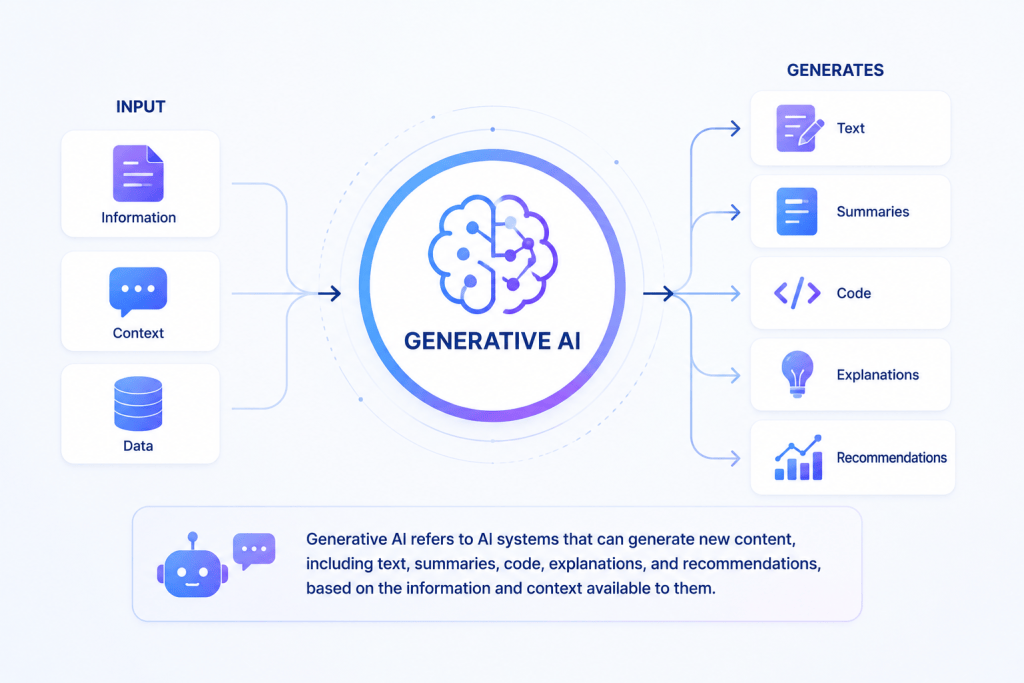
Where Generative AI Changes Business Intelligence
Traditional BI largely followed a structured workflow:
Data → Dashboard → Human Interpretation → Decision
Generative AI introduces a conversational layer:
Data → Question → AI-generated Analysis → Human Decision
Business users no longer need to know exactly where information resides, or which visualization contains the answer. They can begin with the business question.
But many business problems require more than answering one question.
Consider a sales leader asking: “Why are sales declining in the North region?”
Fully understanding this may require identifying when the decline began, determining which products are affected, comparing customer segments, examining pricing or discount patterns, investigating inventory availability, and identifying the most likely drivers.
A generative AI system answers the question asked. It does not independently pursue the investigation required to answer it fully.
This is where Agentic AI becomes relevant.
What Is Agentic AI?
Agentic AI refers to AI systems designed to work toward an objective rather than produce a single response.
Instead of treating every interaction as an isolated question, an agentic system can break a goal into smaller tasks, determine what information or tools it needs, perform a sequence of steps, evaluate intermediate results, and continue until it reaches an appropriate outcome or requires human input.
Agentic Reality Check
Why Enterprise BI is Failing and How to Fix ItA simplified distinction:
Generative AI helps create and explain. Agentic AI helps plan and execute multi-step work toward a goal.
But Agentic AI does not replace Generative AI. Generative models frequently provide language understanding, reasoning, and summarization capabilities inside an agentic system.
A more accurate framing: Generative AI is a capability. Agentic AI is an operating approach built around goals, reasoning, context, tools, workflows, and feedback.

Generative AI vs. Agentic AI: The Key Differences
| Dimension | Generative AI | Agentic AI |
| Primary purpose | Generate, interpret, summarize, or explain | Pursue an objective through multiple steps |
| Typical interaction | Question or prompt → response | Goal → plan → execute → evaluate |
| Workflow | Often user-directed | Can coordinate multi-step workflows |
| Tools | Can use external tools when provided | Can select and orchestrate tools as part of a task |
| Context | Primarily focused on the current interaction | Can maintain task state and broader context |
| Human involvement | User initiates and evaluates responses | Human may supervise, approve, or handle exceptions |
| Execution | Produces information or recommendations | May trigger permitted actions or workflows |
| Feedback | Provided by the user | Can evaluate intermediate outcomes before proceeding |
The distinction is not about one technology being more intelligent than the other. It is about how AI is organized around work.
From Questions to Goals: Why This Matters for Analytics
The biggest change Agentic AI brings to analytics is a shift from question-driven to goal-driven analysis.
Traditional BI asks: “What happened?”
Conversational analytics asks: “Why did it happen?”
Agentic analytics moves toward: “What do we need to understand and do next?”
Take the North region sales decline. A conversational AI system might answer: “Revenue in the North declined 9% last quarter, primarily because sales of two major product categories decreased.”
An agentic analytics workflow could go further. It might identify the declining regions and products, investigate customer and channel patterns, examine relevant operational data, compare the decline against historical behavior, test several possible explanations, prioritize the most significant drivers, and present findings for human review.
The value is not simply a better answer. It is orchestrating the analytical work required to reach the answer.
The Evolution of Business Intelligence
Agentic AI is best understood as part of the broader progression of analytics.
Stage 1: Reporting. What happened? Predefined reports summarized historical performance.
Stage 2: Self-Service Analytics. Where did it happen? Dashboards let users explore data independently.
Stage 3: Augmented Analytics. Why did it happen? Machine learning and anomaly detection automatically surfaced patterns.
Stage 4: Conversational Analytics. Can I simply ask the data? Generative AI reduced the technical knowledge required to interact with analytics.
Stage 5: Agentic Analytics. Can the system investigate the problem with me? AI begins coordinating tasks, tools, and reasoning around a business objective.

Each stage adds capability to the analytics ecosystem. None replaces its predecessor entirely.
Agentic Analytics Does Not Mean Fully Autonomous Analytics
One of the most common misconceptions about Agentic AI is that enterprises must hand complete decision-making authority to autonomous systems. That is neither necessary nor desirable for most business applications.
An AI system might independently gather relevant data, perform analysis, investigate anomalies, compare scenarios, create visualizations, and prepare recommendations. But organizations will typically still require human approval before changing prices, modifying inventory, initiating financial transactions, or executing decisions with regulatory consequences.
The future of enterprise Agentic AI is less about unrestricted autonomy and more about governed autonomy. The right question is not “Can AI act without humans?” It is “Which decisions can AI support or execute safely, under what conditions, and with what level of human oversight?”
Why Governance Becomes More Important as AI Becomes More Agentic
When AI only generates an answer, an incorrect response is an information problem. When AI can initiate workflows or actions, the consequences can become operational.
Enterprises evaluating agentic analytics should consider: What data can the system access? What actions can it perform? Can the reasoning process be examined? When is human approval required? What happens when something fails? Can all activities be audited?
As analytics becomes more agentic, trust architecture becomes just as important as AI architecture.
Which Does Your Organization Need?
For most enterprises, this is not an either-or decision. Generative AI is most valuable when the goal is to improve how people interact with information: conversational queries, report summarization, narrative generation, and data explanation. Agentic AI becomes more relevant when the work involves multiple analytical steps, several tools or data sources, complex investigation, or coordinated workflows. Many enterprise implementations will combine both, with users interacting through a conversational interface while an agentic architecture coordinates the analytical work behind it.
Final Thoughts
Generative AI and Agentic AI are not competing technologies. Generative AI has transformed how people communicate with information. Agentic AI extends that by organizing AI capabilities around goals, tools, feedback, and multi-step workflows.
For business intelligence, the direction of travel is clear:
“Show me the data.” → “Let me ask the data.” → “Help me investigate what is happening, understand why it matters, and determine what we should do next.”
That shift, from information consumption toward active decision support, may ultimately define the next generation of analytics.
Where Lumenore Fits
At Lumenore, we see Agentic Analytics as the natural evolution of business intelligence: from passive information consumption toward goal-oriented analytical experiences that maintain appropriate governance and human oversight throughout. This approach keeps people in control while reducing the effort required to move from question to insight to action.
Frequently Asked Questions
Generative AI generates, interprets, summarizes, or explains information in response to input. Agentic AI pursues broader objectives by planning and coordinating multiple steps, tools, and workflows.
Not necessarily. They serve different purposes and often work together. Generative AI frequently provides language understanding and reasoning capabilities within a broader agentic system.
It can perform certain tasks independently, but enterprise implementations typically require governance, permissions, monitoring, and human approval for higher-risk actions.
Analytics systems that go beyond answering individual questions by coordinating multiple tasks, including data retrieval, investigation, root-cause analysis, scenario evaluation, and recommendations, around a business objective.
It is more likely to change the work analysts perform than eliminate the role. By automating repetitive investigation, it allows analysts to focus on business context, strategic analysis, governance, and decision support.
Generative AI often serves as one component within an agentic system, providing interpretation, reasoning, and explanation, while the broader architecture provides tools, context, task orchestration, and controls.
Data quality, system permissions, security, governance, human oversight, auditability, integration requirements, reliability, and the business processes where agentic capabilities will operate.